
Seychelles culture · History
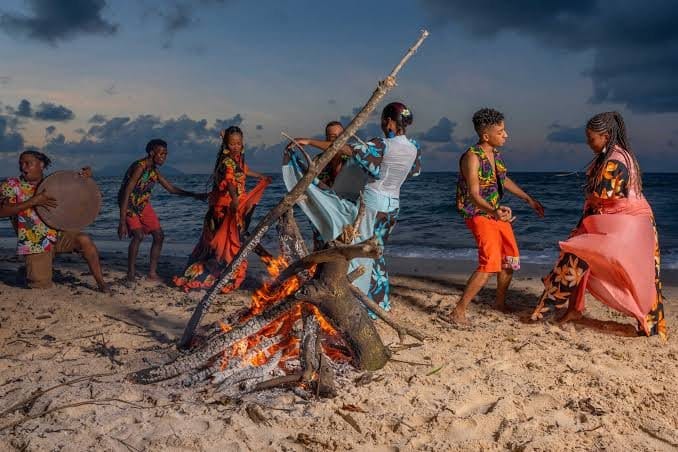
On a Seychelles beach after dark, someone builds a fire of dry palm fronds. The drummers hold their goatskin drums close to the flames until the skins pull tight and ring. Then a man calls out a line, the women answer, and the moutya begins. It looks like a celebration, and it is one. It is also the oldest surviving record of what it meant to be enslaved on these islands. And for 83 years, a colonial law silenced its drums at nine o’clock at night in the places where most people lived.
Quick answer
Moutya is the traditional drum dance of Seychelles. Enslaved Africans brought it to the islands in the 18th century and danced it at night in the forest, far from the planters’ houses. A British regulation of 9 August 1935 banned drumming after 9 p.m. in and around Victoria and four other districts. It was repealed on 30 August 2018, and UNESCO inscribed moutya on its list of the Intangible Cultural Heritage of Humanity on 15 December 2021, the first Seychelles tradition ever listed.
Born in the dark
Seychelles had no people until 1770, when a small party of French settlers landed with the Africans and Malagasy they had enslaved. The plantations grew fast. By the time Britain abolished slavery across its empire on 1 February 1835, 6,521 people were freed in Seychelles, out of roughly 7,500 inhabitants. According to the emancipation figures, 3,924 of them had been born in Mozambique.
That number matters, because it tells you where the dance came from. The Seychellois Creole word moutya is of Bantu origin. Annegret Bollée’s etymological dictionary of the Indian Ocean creoles traces it to a dance of the Makua, a people of northern Mozambique. The drum crossed the ocean inside the memory of the people who were shipped across it.
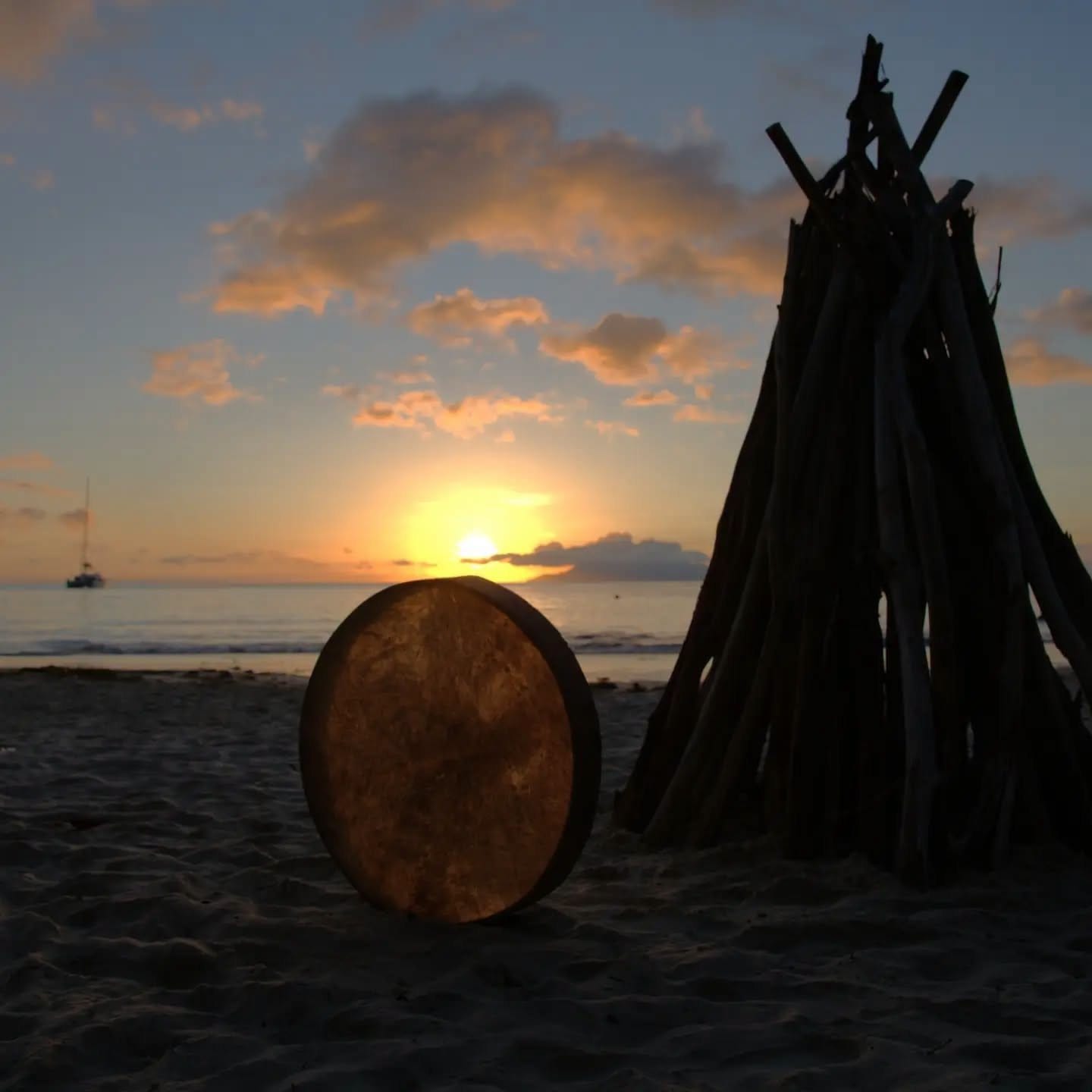
What they built on the plantations was a dance for the night. UNESCO’s own description is plain about it. Enslaved people danced moutya in the forest, at a distance from the plantation house where their masters lived
, and the dance served as a psychological comfort against hardship and poverty and a means of resisting servitude and social injustice
. French colonial law forbade enslaved people from different estates to gather, so the drum had to live out of earshot.
The oldest songs still carry that distance. One of them, recorded by the government’s oral traditions researchers in 1981, is the lament of a man who once carried a war spear. There is no record of a war spear ever being used in Seychelles. The Seychellois scholar Penda Choppy reads it as a memory that can only have belonged to someone born free in Africa. The word for sleep, doumi, is an archaic form older people still recognise.
Aswar mon napa doumi
Zot aswar mon napa doumi
Kan mon mazin mon lans deger
Nek delo i vin dan mon lizye
At night I cannot sleep
Oh, at night I cannot sleep
When I think of my war spear
Only tears come to my eyes
Freedom in 1835 did not end the hardship. The freed men and women were bound as “apprentices” to their former owners until 1839. Between 1861 and 1874, Royal Navy patrols stopped slave dhows off the East African coast and landed more than 2,500 rescued Africans at Mahé, where most were indentured to work on the plantations. The moutya absorbed all of it.
The law that named the drum
By the twentieth century the moutya had outlived slavery, and the colony wanted it quieter. The Catholic Church condemned the dance as indecent, and the drums carried across the still tropical nights to the planters’ houses. On 9 August 1935, the British Governor used section 183(2) of the Penal Code to publish the Drums Regulations. Here is the operative text, exactly as it appears in the colony’s official 1952 edition of its laws.
Penal Code · Chapter 93 · Section 183 (2) · 9th August, 1935
Drums Regulations
Notice is hereby given that His Excellency the Governor has, under the authority of section 183 (2) of the Penal Code, been pleased to describe the following areas within which the beating of drums or tambours or the blowing of shells, etc., at night after 9 p.m. are prohibited:
- Within the town of Victoria and a distance of one mile outside the limit thereof.
- Within a radius of three-quarters of a mile from the police station at Anse Royale, Mahé.
- Within a radius of three-quarters of a mile from the police station at Baie Ste. Anne, Praslin.
- Within the area situated in the district of Grand’ Anse, Praslin, and lying between the Morico Bridge on the North and the Nouvelle Découverte Bridge on the South and between the seashore on one side and an imaginary line inland three-quarters of a mile distant from the sea-shore and parallel thereto on the other side.
- Within a radius of three-quarters of a mile from an imaginary point half way between the police station and the Roman Catholic Church in the district of La Passe, La Digue.
Amended by Legal Notice 40 of 1937. Repealed 30 August 2018.
Read it closely. The regulation never mentions a dance, and it never mentions a voice. It names the drum, the tambour, and the conch shell. It draws its circles around police stations, the capital, a busy coastal strip on Praslin and the church at La Passe. For a dance that only happened at night, around a fire, with the drum at its centre, a ban on drumming after nine in the places where people lived was a ban on the moutya in all but name. A second notice in 1937 widened the prohibited areas.
It names the drum and the shell. It never names a voice.
So the moutya moved. The historian Tony Mathiot has pointed out that it survived far more on the outer islands than on Mahé, because the restrictions bit hardest on the main island. People held it in prearranged weekend gatherings, out of range of the police stations. And because respectable society had been taught to see it as crude, the stigma outlasted the colonial era itself. Well into the 1970s and 1980s, many young Seychellois were embarrassed to be seen dancing it.
Songs that kept the record
A moutya song is not written down. It is composed on the night, in front of everyone, and whatever the community cares about goes into it. That is why the surviving lyrics read like an archive. Many were made by labourers on the outer islands, the copra and guano islands where men signed five-year contracts and saw their families once a boat came in.
This one is about a child worker. He gives his age as twelve or fourteen, husks coconuts on Alphonse and digs guano on Assumption. When he finally steps off the boat and asks for his wages, the boss laughs at him.
Dan mon dou-z-an katorz an
Piti mon manman dan lakour
Mon al plis koko lil Alfons
Mon al tir gwano Lasonmsyon
Mon pa pou peye ozordi
Vin demen nev-er bomaten
Ou lapey en boutey diven
At twelve, at fourteen years
Still my mother’s child at home
I went husking coconuts on Alphonse
I went digging guano on Assumption
I won’t pay you today
Come back tomorrow, nine in the morning
Your wages are a bottle of wine
Other songs name punishments. In “Zil mon bourzwa” (Jules, my master) a worker who talks back is thrown into a cell beside the copra kiln, and when he cries out from the heat the boss sends his makro to cut his hair. Makro means mackerel in Creole, and it came to mean the man who curries favour with the boss and informs on his own people. He appears in song after song, and nobody has a kind word for him.
The moutya also worked as an open court. A widow who took a lover the day after her husband’s funeral, a wife who boasted that her husband was a craftsman when he picked coconuts, a gossip who twisted people’s words. Each of them could hear their business sung back to them around the fire, with the whole district laughing. Researchers found songs about the Bel Air hill being too steep for the early lorries, about the monthly supply boat, about love, betrayal and being far from home. Put together, they are a people’s history told by the people it happened to.
How a moutya night works
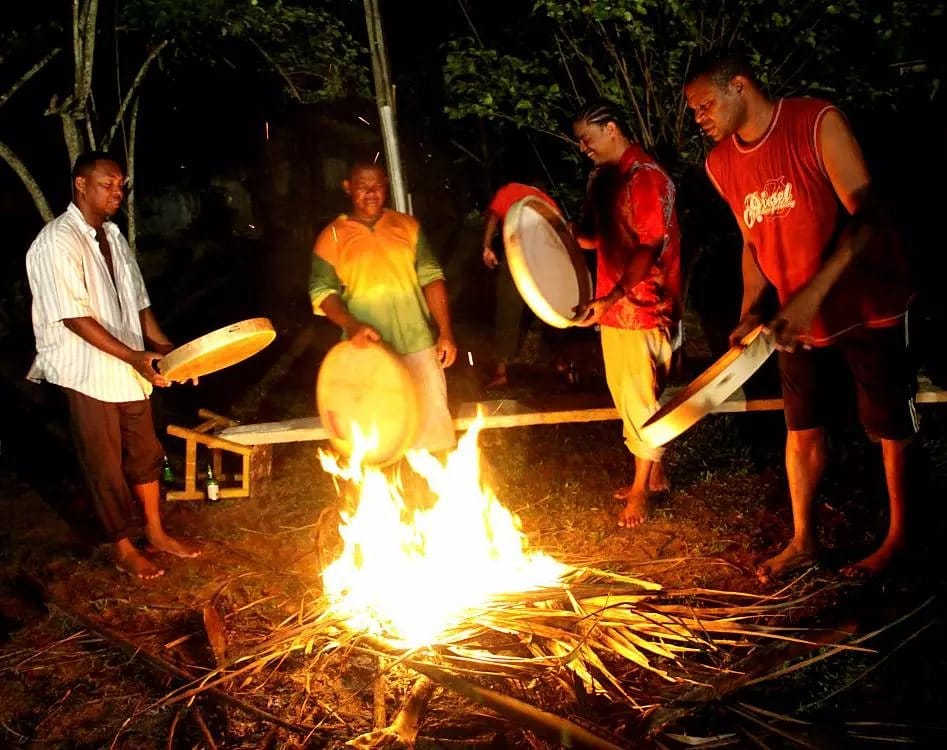
The drum is the tanbour moutya, a wide, shallow frame drum. Traditionally its hoop was bent from bwa var, the coastal hibiscus tree, and its face was scraped and dried goatskin, glued and laced to the frame. Goats were plentiful in the early settlement, so goatskin was the obvious choice. A classic set has three drums of different sizes, called manman (mother), papa (father) and piti (child), and each keeps its own pattern while the three lock together.
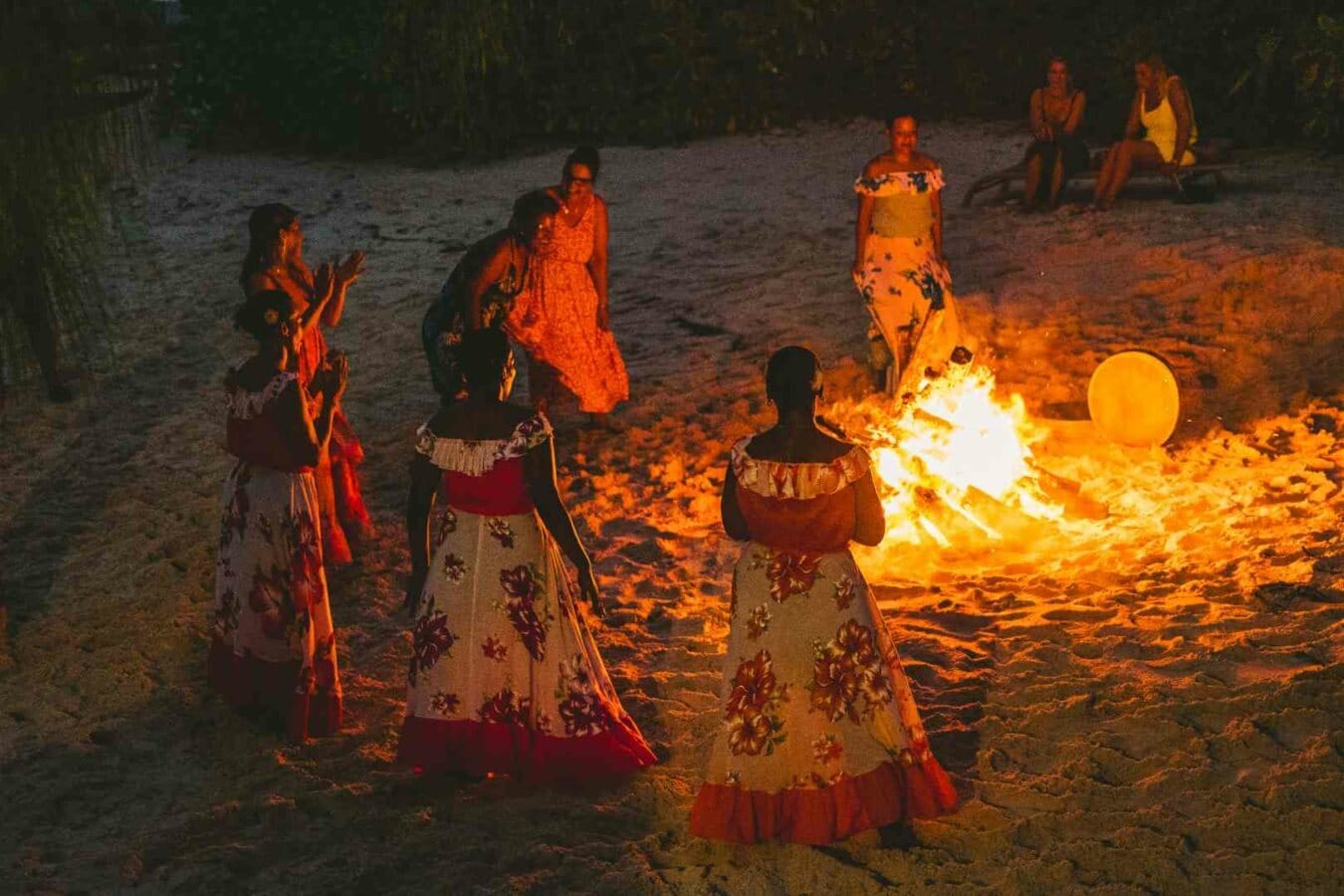
The fire. Dry palm fronds are lit on the sand or in a yard. Traditionally the women gathered them.
Heating the drums. Goatskin slackens in the humid night air. The drummers hold the skins to the flames until the pitch rises and the drum rings.
The call. A male singer calls the opening line and the chorus takes it up, so it is heard three times. It can be a joke, a complaint or a piece of gossip.
The answer. The women respond in high, bright voices. The last line of each verse is the punchline and becomes the first line of the next.
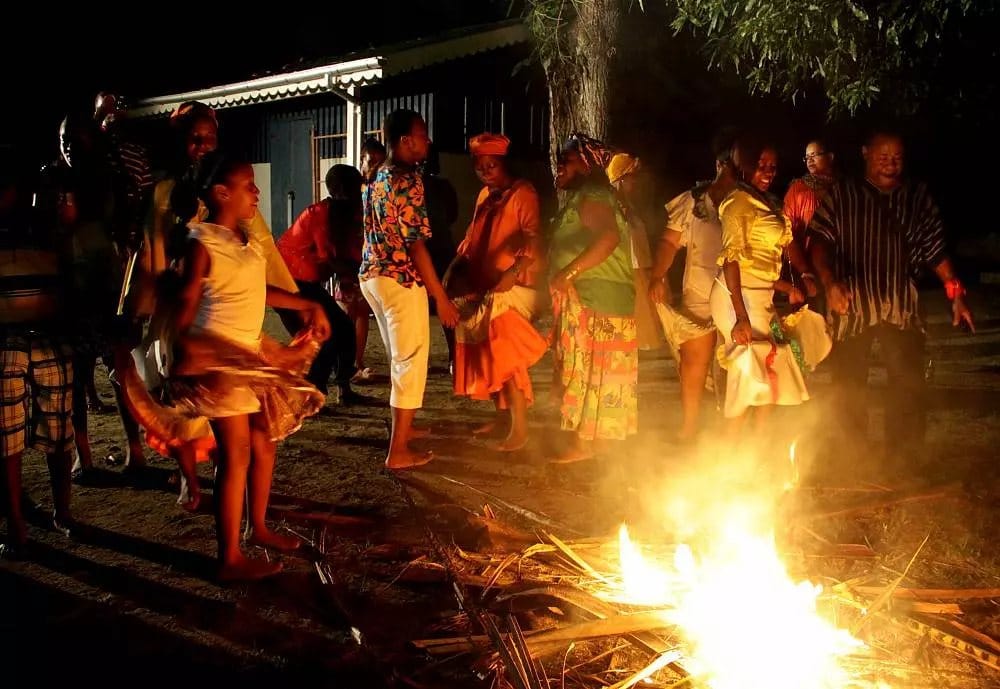
The dance. Couples face each other, hips swaying, feet shuffling in the sand. They come very close and never touch. The tempo climbs as the drums heat up.
The close. An ululation of olae, olae ends a song. If the drums are still hot, someone starts the next one.
The singers talk to the drummers the whole time, and not always politely. Tanbourye, ki kote ou ete?
goes one traditional call, “Drummer, where have you gone?”, when the beat starts to sag. A singer who runs dry, or who has not been given enough baka, the local cane brew, will threaten to walk off. The audience is part of the show. Choppy describes the moutya as theatre in its own right, with a male chorus, a female chorus, the drummers, the dancers and the spectators all playing a role.
It was also, for most of its history, adult entertainment. The lyrics run on double meanings, and at the height of an old-style moutya the dancing could get wild. That is part of why the Church fought it and part of why the colony found it easy to restrict. The moutya you see today is gentler, though still very much a dance for grown-ups.
The drum changes sides
In the 1960s the independence movement understood what the moutya was. The Seychelles People’s United Party brought moutya to its rallies and, in one of its early publications, called the moutya singer the new politician of the day
. Its literature described the restrictions on the dance as a war on Seychellois culture. A form of expression that had begun as resistance to slavery became a way of gathering people against colonial rule.
The songwriter Patrick Victor wrote one of his first songs, Tanbour Moutya, about the drum itself, in the mid-1970s. Seychelles became independent on 29 June 1976. After 1977, the government of the Second Republic put moutya and the Creole language at the centre of a new national identity. Kreol was made an official language in 1981. That same year, researchers from the Culture Division began recording older singers before the old lyrics could die with them, and published the first collection, Sanson Moutya, in 1982. The first Festival Kreol followed in 1985.
The drum had changed sides, but it kept its edge. When multi-party politics returned in 1993, the opposition warned the ruling party with a moutya line: Sa ki anler i kapab desann, sa ki anba i kapab monte
. “What is on top can come down, and what is at the bottom can rise.” From the 1990s, Patrick Victor led a long revival, teaching the drum and recording at his studio in Bel Ombre. His view of the dance is short. Moutya is our link with our ancestors.
One thing did not change. The 1935 Drums Regulations were never repealed. For 42 years after independence, the law that restricted the drum sat quietly on the statute book of the country that had made the drum its symbol.
Repeal and the road to UNESCO
Work on a UNESCO nomination began in September 2015, and it did not go smoothly. Part of the job was clearing the colonial law away. The Department of Culture took the repeal to the Cabinet, and on 30 August 2018 President Danny Faure signed the statutory instrument that ended Regulation 115 of 1935, 83 years after it was published. That same year Patrick Victor was teaching moutya drumming to primary pupils in four schools in the north of Mahé. They don’t believe this is the music of slaves
, he said of the children. Moutya is a sacred music.
The first dossier reached UNESCO’s committee in December 2019, and it came back. The committee accepted that moutya was a living, widespread tradition with the full consent of its community. It referred the file, because it found the proposal leaned on commercial and tourism approaches and warned that the plan risked the over-commercialisation of the dance and could strip it of its context. It is worth saying plainly, on a travel website, that UNESCO was right to ask the question.
Seychelles rewrote the file. The second version put the community first. It cited drumming classes, research, the repeal of the 1935 law, plans for drum-making guidelines and exchanges with related traditions abroad. It counted ten active moutya groups and eighty-four practitioners on three islands. On 15 December 2021, meeting online, UNESCO’s Intergovernmental Committee inscribed moutya on the Representative List of the Intangible Cultural Heritage of Humanity (decision 16.COM 8.b.37). It was the first element from Seychelles ever to be listed.
The moutya’s cousins around the Indian Ocean had got there first. Réunion’s maloya was listed in 2009, the traditional sega of Mauritius in 2014, the sega tambour of Rodrigues in 2017, and the sega tambour of the Chagos Islands in 2019. All of them grew from the same history of enslavement, and the two sega tambour traditions share the moutya’s fire-heated frame drum.
For the first anniversary, on 16 December 2022, the Creative Seychelles Agency organised Moutya Dan Lavil, “moutya in town”, with moutya groups playing in the Stad Popiler car park in Victoria from four in the afternoon until late. That is the town where, for 83 years, drumming after nine at night had been an offence.
Moutya timeline, from 1770 to today
- 1770
French settlers land in Seychelles with enslaved Africans and Malagasy. The moutya grows on the plantations, danced at night in the forest.
- 1835
Slavery is abolished on 1 February. 6,521 people are freed, 3,924 of them born in Mozambique. Apprenticeship ties them to former owners until 1839.
- 1861 to 1874
More than 2,500 Africans freed from slave dhows by the Royal Navy are landed at Mahé.
- 1935
9 August. The Drums Regulations ban drumming and the blowing of shells after 9 p.m. in five districts of Mahé, Praslin and La Digue.
- 1937
Legal Notice 40 of 1937 extends the prohibited areas.
- 1960s
The independence movement brings moutya to its rallies and calls the moutya singer “the new politician of the day”.
- 1975
Patrick Victor’s early song Tanbour Moutya, usually dated to 1975, celebrates the drum.
- 1976
Independence, 29 June. The Drums Regulations stay in force.
- 1981 to 1985
Kreol becomes an official language. Moutya songs are recorded and published as Sanson Moutya. The first Festival Kreol is held.
- 2010
Moutya enters the national inventory of intangible cultural heritage in November.
- 2015
Work on the UNESCO nomination begins in September.
- 2018
30 August. President Danny Faure repeals the 1935 Drums Regulations.
- 2019
UNESCO refers the first nomination back, citing the risk of over-commercialisation.
- 2020
30 August, 6 p.m. Districts on Mahé, Praslin and La Digue hold a “moutya hour” for the second anniversary of the repeal.
- 2021
15 December. UNESCO inscribes moutya on the Representative List of the Intangible Cultural Heritage of Humanity.
- 2022
16 December. Moutya Dan Lavil is organised in the centre of Victoria for the first anniversary.
Watch moutya
Reading about moutya only gets you so far. These four films show the drums, the voices and the dance.
 Play the UNESCO film on moutya
 Play the Cultur’Îles film on moutya
 Play the moutya performance clip
 Play the Moutya Dan Lavil invitation
Seeing moutya as a visitor
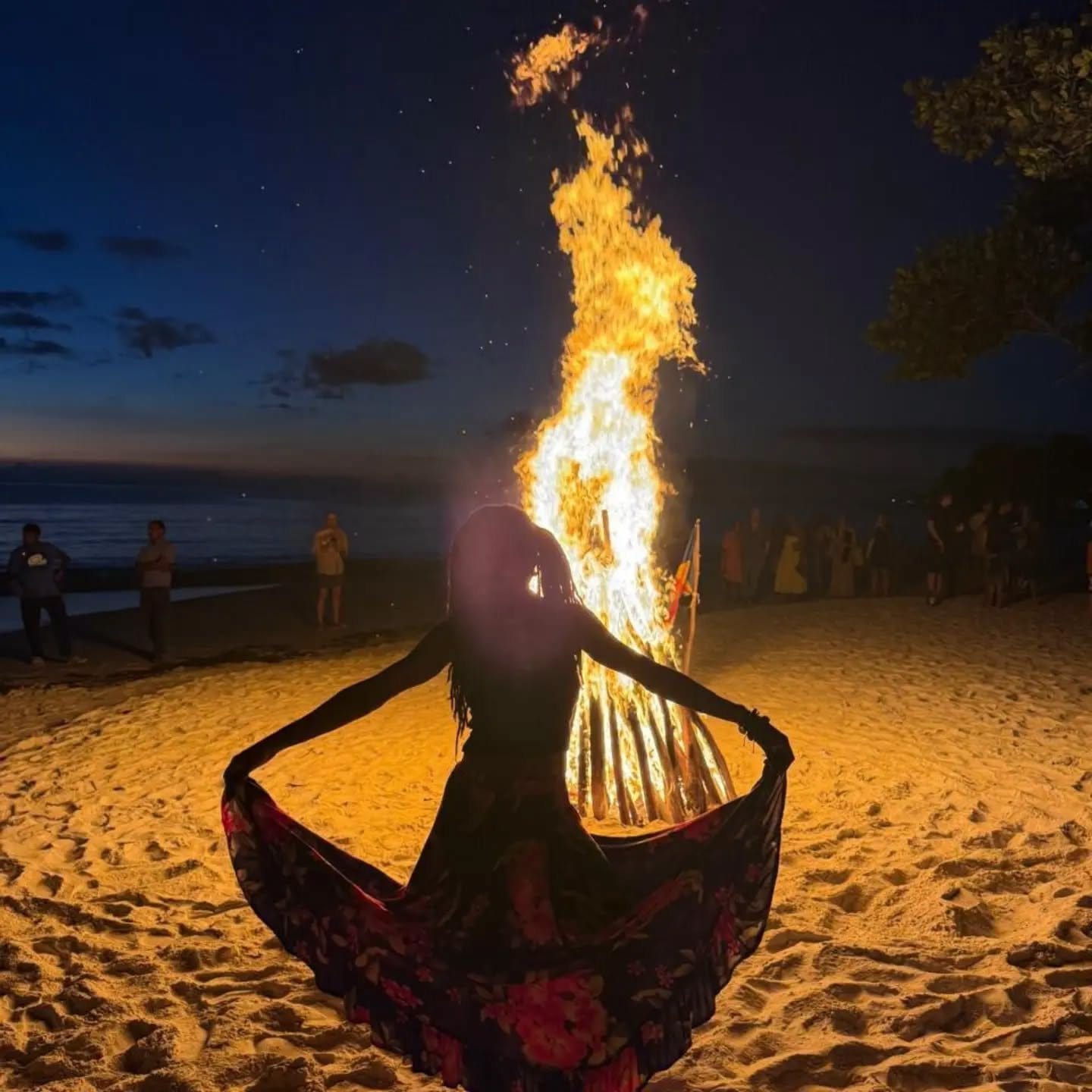
Moutya is not a stage show that runs on a timetable. It happens at community events, at family celebrations and at national moments, and those are the best places to find it. Three dates are worth planning around.
- Festival Kreol, late October. The Creole festival runs across the islands every year in the last week of October, around International Creole Day on 28 October. Moutya is part of the festival’s cultural programme. See our Seychelles festivals guide.
- The repeal anniversary, around 30 August. Cultural bodies have marked the end of the Drums Regulations with moutya evenings and the Lafet Moutya Sesel celebration.
- The UNESCO anniversary, mid-December. The inscription date of 15 December has been celebrated with open-air moutya in Victoria.
Outside those dates, many beach hotels host a weekly Creole evening with a moutya group around a fire, and it is always worth asking at your hotel or guesthouse what is on during your stay. Local groups also play at district events and private parties, and the invitation is usually informal.

A few simple courtesies go a long way.
- Remember what it is. This is heritage born under slavery, and for many families it still carries that weight. Treat it as you would treat any living tradition, not as a floor show.
- Join when you are invited. Dancers often pull the audience in. Say yes. Nobody expects you to know the steps, and the rule of the dance is to come close without touching.
- Ask before you film faces. Wide shots of the fire and the drums are fine. A close-up of someone’s face is theirs to agree to.
- Arrange your ride home. Moutya starts after dark and runs late, and buses stop early. Having your own car or a booked taxi makes the evening easy.
Plan an evening around the drums
Festival nights move around the island, and the best moutya is often a drive away. A car gives you the freedom to follow the music and get back safely after midnight.
Moutya: frequently asked questions
What is moutya in Seychelles?
Moutya is the traditional drum dance of Seychelles, created by enslaved Africans on the plantations and danced at night around a bonfire. Men beat goatskin frame drums heated over the fire, a male singer calls improvised lines, the women answer, and couples dance close without touching. UNESCO listed it as intangible cultural heritage in 2021.
Was moutya banned in Seychelles?
Not by name. The British Drums Regulations of 9 August 1935 prohibited beating drums or blowing shells after 9 p.m. in Victoria and one mile around it, near the police stations at Anse Royale and Baie Ste Anne, along Grand'Anse on Praslin and at La Passe on La Digue. Because moutya is a night dance built on the drum, the rule pushed it out of those areas. The Church also condemned it. The regulations were repealed on 30 August 2018.
When did moutya become UNESCO heritage?
On 15 December 2021, UNESCO inscribed moutya on the Representative List of the Intangible Cultural Heritage of Humanity, by decision 16.COM 8.b.37. It was the first element from Seychelles to be inscribed. An earlier nomination was referred back to Seychelles in 2019.
Where does the word moutya come from?
The word is of Bantu origin. Annegret Bollée's etymological dictionary of the Indian Ocean creoles links it to a dance of the Makua people of northern Mozambique. In 1835, more than half of the enslaved people freed in Seychelles had been born in Mozambique.
What is the difference between moutya and sega?
Both are Creole dances of the Indian Ocean. In Seychelles, the sega is danced with the feet close together and the movement in the hips, and it allows a wider range of rhythms. The moutya is danced with the feet set wide apart, is built on heated goatskin frame drums and call-and-response singing, and keeps to a small set of traditional rhythmic patterns.
What drum is used for moutya?
The tanbour moutya, a wide and shallow frame drum. Traditionally the hoop is bent from bwa var, the coastal hibiscus, and the skin is goat hide. Drummers heat it over the bonfire to tighten the skin before playing. A classic set has three sizes, called manman, papa and piti.
Where can I see moutya in Seychelles?
At Festival Kreol in the last week of October, at events around 30 August marking the repeal of the drum law, and around the UNESCO anniversary in mid-December. Many beach hotels also host a weekly Creole evening with a moutya group, so ask your hotel or guesthouse what is on during your stay.
Can visitors join a moutya dance?
Yes, when invited, and dancers often pull the audience in. Nobody expects you to know the steps. Dance close to your partner without touching, ask before filming people's faces, and remember that for many Seychellois the dance carries the memory of slavery.
Sources
This article is built on primary documents. The text of the 1935 regulation is quoted from the colony’s official revised edition of its laws. The song lyrics are traditional and were collected by the Seychelles Culture Division in 1981 and the Creole Institute in 2007. The English translations are our own.
- Colony of Seychelles, Drums Regulations, 9 August 1935, Penal Code Cap. 93 s.183(2), in Subsidiary Legislation of Seychelles in force on 30 June 1952, p. 445. Via the African Drumming Laws archive.
- UNESCO, Moutya, Representative List of the Intangible Cultural Heritage of Humanity, file 01690.
- UNESCO Intangible Heritage Committee, Decision 16.COM 8.B.37 (inscription, 2021) and Decision 14.COM 10.B.32 (referral, 2019).
- Penda Theresia Choppy, Attitudes to Slavery and Race in Seychellois Creole Oral Literature, MA thesis, University of Birmingham, 2017. Chapter 4, “The Seychelles Moutya”.
- Seychelles Nation, “Moutya added to Unesco list of intangible cultural heritage”, December 2021.
- Seychelles Nation, interview with Patrick Victor, 2022.
- SBC, “6 reasons why Moutya has a special place in Seychellois culture”, October 2022.
- SBC, “Youth in Seychelles drum their moutya beats to preserve dance heritage”, August 2022.



Comment (0)