Every beach in Seychelles is public by law, up to the high water mark, so nobody can sell you a beach they own. A wedding beach is private only when there is no way onto the sand except across private land. Ours is exactly that, a cove on Mahé reached only through the property in front of it, with a bathroom and changing area a few steps away.
“Private beach wedding” is the most repeated phrase in Seychelles wedding marketing, and most of the time it is not true. Here is what the law actually says, why our beach is the exception, and the five questions to ask anyone who promises you privacy.
We get asked about privacy more than we get asked about price. Couples flying eleven hours to say two sentences to each other do not want a stranger in swimming shorts walking through the back of the photograph, and they are right not to. So this guide does something the brochures avoid. It explains how beach ownership works in Seychelles, what resorts mean when they say “our beach”, and the one geographic accident that lets us promise a couple that nobody will be on the sand except the people they invited.
What the law says about beaches in Seychelles
Seychelles follows the French legal tradition, and its Civil Code treats the foreshore as public domain. In practice that means the beach up to the high water mark belongs to the Republic and every person in the country has the right to be on it. A landowner can own the coconut palms, the lawn and the house behind the sand, but not the sand itself, and not the water. The Civil Code of Seychelles Act 2020, which replaced the 1976 code, carried that principle forward unchanged.
The point has been argued in public for decades. A well known 2006 column in the Seychelles Weekly set out the position under the Civil Code articles on ownership, possession and prescription, and reached a blunt conclusion. Where a right of way to a beach existed before a property changed hands, the new owner cannot close it. It also warned that if the community stops using an access path for twelve years, the path can be lost to prescription, which is why Seychellois still walk through certain resort gates on principle.
Neighbouring Mauritius has the same rule written even more explicitly, with its Beach Authority Act keeping everything between the high water mark and a line out to sea public even in front of the most expensive hotels. Seychelles never needed a separate act because the Civil Code already did the job. The upshot for a couple is simple. No operator, resort or villa in Seychelles can legally sell you a beach. They can only control how you get to it.
What resorts mean by “our beach”
Most of the big hotels on Mahé and Praslin sit on beaches that are, in law, open to anyone. What they have is the land behind the sand and the only road in. So the beach at a five star resort is effectively private on a quiet day, and effectively shared the moment a group of locals or a boat of day trippers arrives, which they are perfectly entitled to do. Some properties ask non guests to check in at reception before walking through. None of them can stop a person arriving by sea or along the rocks at low tide.
That is not a criticism. It is just the reality, and it is why a “private beach wedding” at a resort usually means a ceremony on the lawn or the deck above the sand, with the beach itself as backdrop. If you are happy with that, it is a lovely way to marry. If you want your feet in the water while you say your vows, and no one else in the frame, the geography of the beach matters more than the star rating of the hotel.

Why our beach is the exception
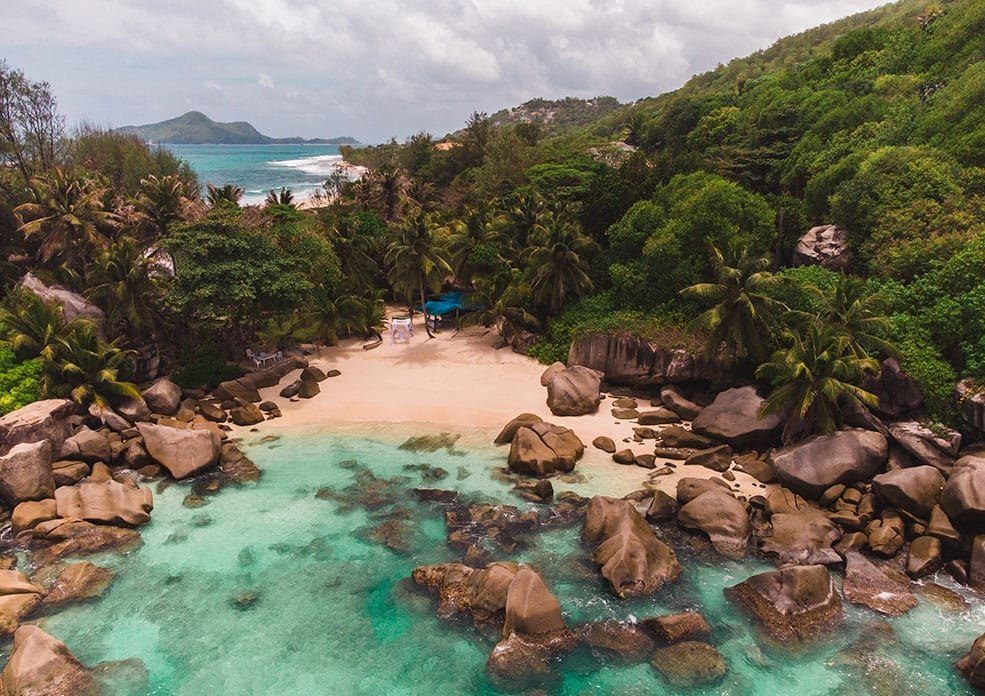
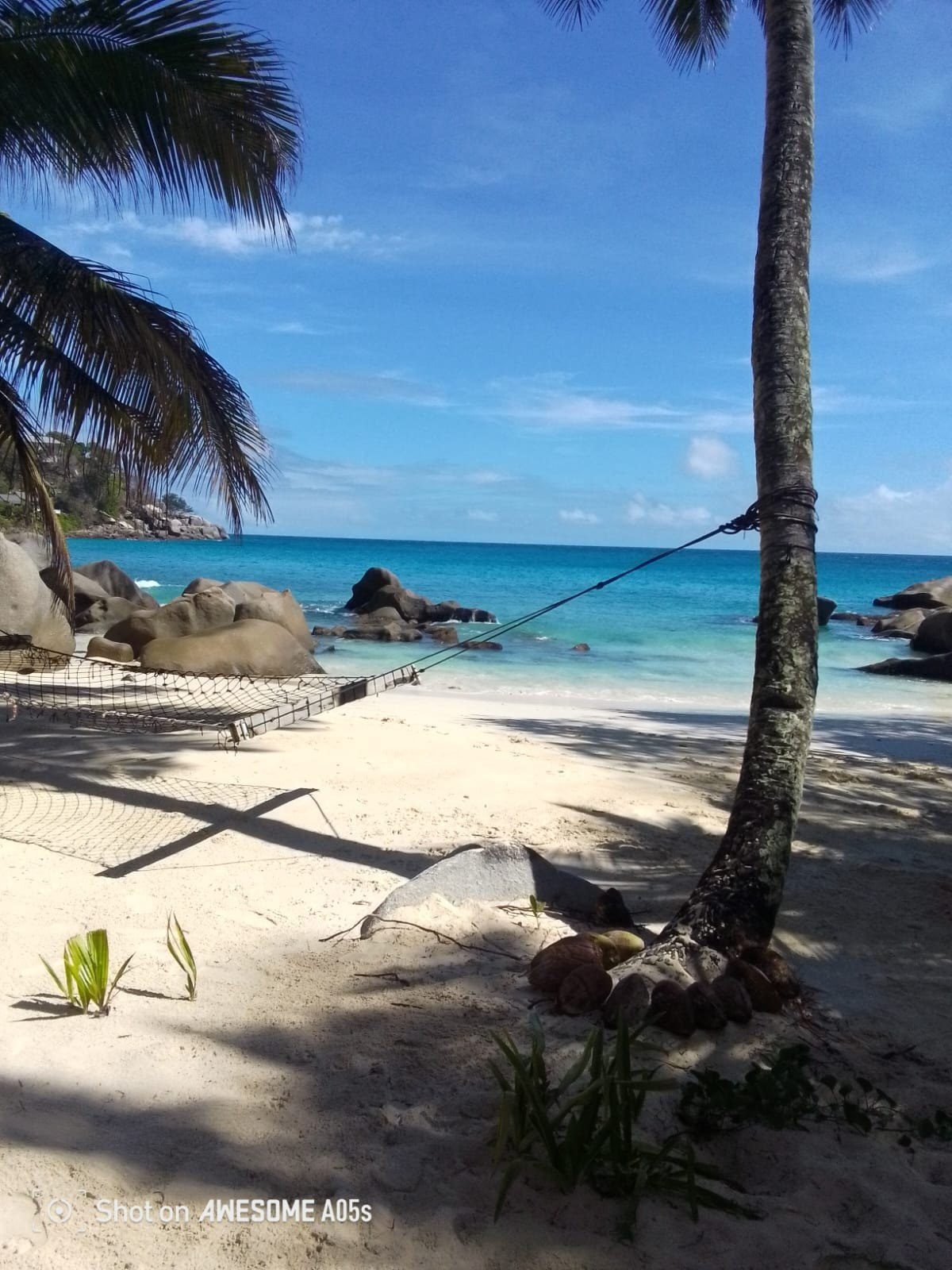
The beach we use for most Mahé weddings is a small cove on the quieter side of the island. It is public, like every other beach in the country. What makes it different is that there is no road to it, no footpath along the coast into it, and granite headlands on both sides that you cannot walk around even at low tide. The only way onto the sand is through the private property that sits directly behind it, and that property lets us use the crossing for our weddings.
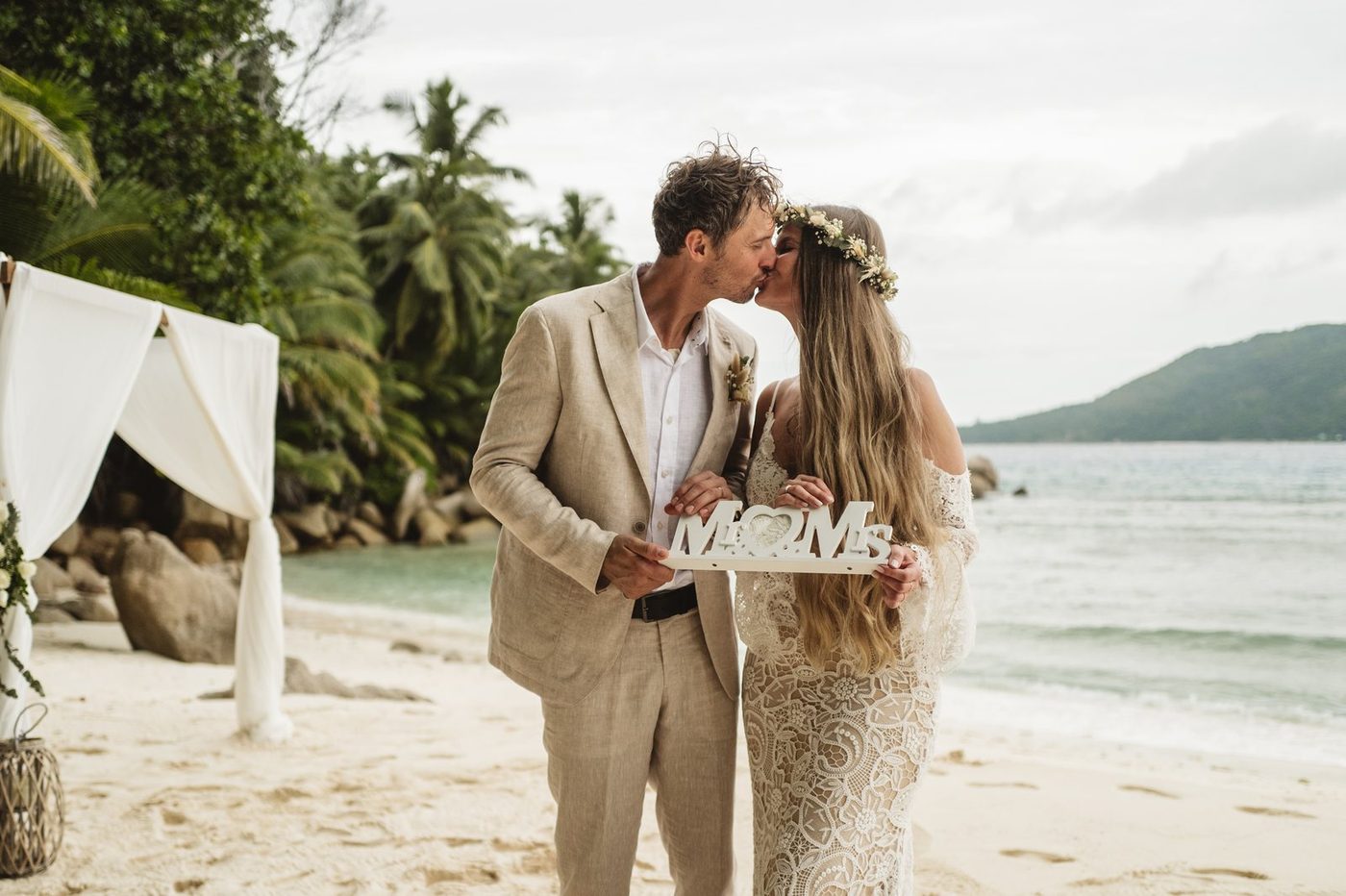
We are careful about how we describe this, because it is the whole basis of the promise we make. We do not own the beach. We control the only door. On the afternoon of your wedding that door is closed to everyone except you, your guests, the registrar, our team and your photographer. In nine years of weddings there we have not had a stranger walk into a ceremony, and it is not luck. It is a headland.
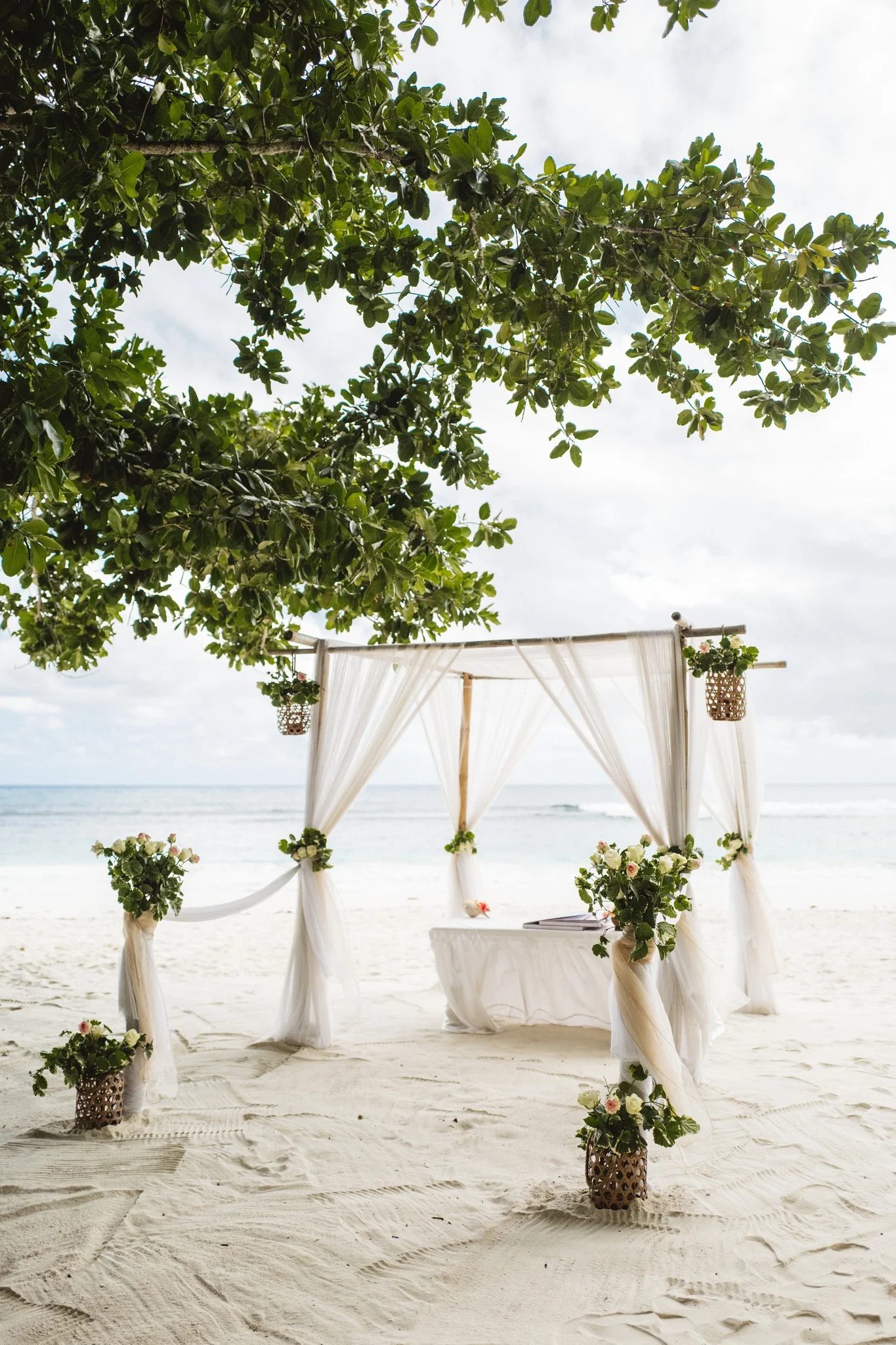
The practical side matters as much as the privacy. There is a proper bathroom and a changing area a few steps from the sand, which sounds small until you have seen a bride try to fix a dress behind a palm tree on a public beach. There is shade under takamaka trees for guests who do not want an hour in the sun. The bamboo gazebo goes up on the same patch of sand every time because we know exactly where the light falls at two in the afternoon. And the water in front is a sheltered reef lagoon, so the photographs in the shallows are calm rather than heroic.
Where exactly is it? We do not publish the location. Every couple who books with us receives the map pin and the coordinates so their family and photographer can find it, and that is where it stays. A beach that is private because nobody knows the way in stops being private the moment its coordinates sit on a public web page.
What privacy actually changes on the day
The obvious thing is the photographs. Look through the To Happy Endings gallery and you will notice there is never a sunbather, a parked boat or a volleyball game in the background, and that is not editing. The less obvious thing is how the couple behaves. People relax when nobody is watching. Vows get read slower. The groom cries. The bride kicks water at the photographer. None of that happens as easily when a family from a neighbouring hotel has stopped to take pictures of your ceremony on their phones, which on a public beach they will, and which you cannot stop.
Privacy also changes the timing. On a public beach we would be pushed towards early morning, before the day trippers arrive, which means a six o’clock start for the stylist. On our beach the ceremony sits comfortably at two in the afternoon and the photographs run into the softer light after four, with the whole day paced the way we describe in our hour by hour wedding day guide.

When we still recommend a public beach
Privacy is not the only thing a couple can want. Anse Intendance on the south of Mahé is one of the most dramatic beaches in the country, a long crescent with big surf and no reef, and it photographs like a film set. Anse Source d’Argent on La Digue is the most photographed beach on earth for a reason. Both are public, both get busy, and both are worth it for the right couple. When someone asks for that scale of drama we plan an early ceremony, choose the quiet end of the beach, and are honest that a passer by is possible.
The same honesty applies to Praslin and La Digue generally. They are beautiful and they involve a ferry, a second team and public sand, which is why our Praslin package is €1,990 and La Digue €2,090 against €1,645 on Mahé, and why around 95 in every 100 of our couples choose Mahé. Compare the three on our wedding packages page.
Five questions to ask anyone promising you a private beach
- Is the beach itself private, or the land behind it? The honest answer in Seychelles is always the land. Anyone who says they own the beach either does not understand the law or hopes you do not.
- How does a member of the public reach the sand? If there is a road, a coastal path or a walk around the rocks, the beach is shared. If the only answer is “through our property”, you have found a genuinely private beach.
- Where is the nearest bathroom? Ask this one out loud. On a public beach it is often a fifteen minute drive.
- What time will the ceremony be, and why? A six in the morning ceremony is usually a sign the beach is public and they are dodging the crowds.
- Can we see photographs of a recent wedding there with the background visible? Tightly cropped portraits hide a lot. Wide shots tell the truth.

The short version, for couples in a hurry
All beaches in Seychelles are public. Nobody owns one. A beach is private for your wedding only when there is no way in except across private land, and that is the situation on the cove we use on Mahé. It comes with a bathroom, a changing area, shade and a sheltered lagoon, it is the same beach you see in almost every film on our YouTube channel, and it is included in the Mahé wedding package at no extra cost. If you want drama instead of privacy, we will say so and plan accordingly.
Frequently asked questions
Are there private beaches in Seychelles?
Not in law. The Civil Code treats every beach up to the high water mark as public domain, so no person, hotel or company can own one. A beach becomes private in practice only when there is no access to it except across private land, which is rare. The cove we use for weddings on Mahé is one of those cases.
Can we legally get married on a beach in Seychelles?
Yes. The civil ceremony is conducted by an officer of the Civil Status Office, and Seychelles is one of very few countries where that officer will marry you directly on the sand. We lodge the notice of marriage 11 days ahead, arrange the venue, and the ceremony on the beach is the full legal marriage, not a symbolic one.
Do you own the beach you use for weddings?
No, and nobody in Seychelles could. What we have is the use of the only route onto that beach, which runs through the private property behind it. Granite headlands close both ends, so on your wedding afternoon nobody else is on the sand.
Is there a bathroom and somewhere to change at the beach?
Yes. A proper bathroom and a changing area sit a few steps from the sand, plus shade under the trees for guests. That is one of the main reasons we use this beach rather than a more famous public one, where the nearest facilities can be a long drive away.
Will you tell us where the beach is before we book?
We share the map pin and coordinates with every couple once they are booked, so family and photographers can find it. We do not publish it, because a beach that is private only because few people know the way in would stop being private the day its location went online.
What about a wedding at Anse Intendance or Anse Source d’Argent?
Both are public and both are spectacular. We arrange weddings there for couples who want that scale of scenery, usually early in the day at the quiet end of the beach, and we are honest that passers by are possible. Our private cove is the choice when privacy matters more than drama.
- Civil Code of Seychelles Act, 2020, consolidated on SeyLII, public domain and ownership provisions. seylii.org
- Seychelles Weekly, Beach Access Laws, on rights of way to beaches under the Civil Code and the twelve year prescription rule. www.seychellesweekly.com
- Adventure.com, on Mauritius Beach Authority Act and the parallel public beach rule in Seychelles. adventure.com
- Immigration and Civil Status, Republic of Seychelles, marriage registrar FAQ, notice of marriage and fees for foreign couples. www.ics.gov.sc
- Civil Status Act of Seychelles, on the celebration of marriage by an officer of civil status. citizenshiprightsafrica.org
- Seychelles Meteorological Authority, climate guide, for sea and wind conditions by season. www.meteo.sc
Mahé from €1,645, private cove included
Ask us for the wide shots.
Send your date and we will reply with recent photographs of the cove with the whole background visible, the map pin once you book, and an honest answer about any other beach you have in mind.


Comment (0)